NeurIPS 2026 · Spotlight

UDT: Reconciling U-Nets and Diffusion Transformers
with Data-Adaptive Token Reduction

University of Minnesota

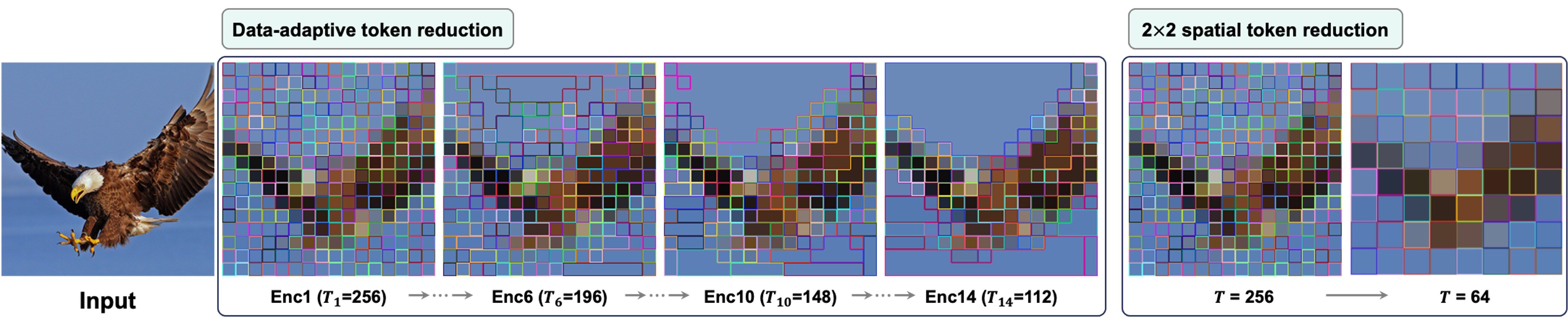
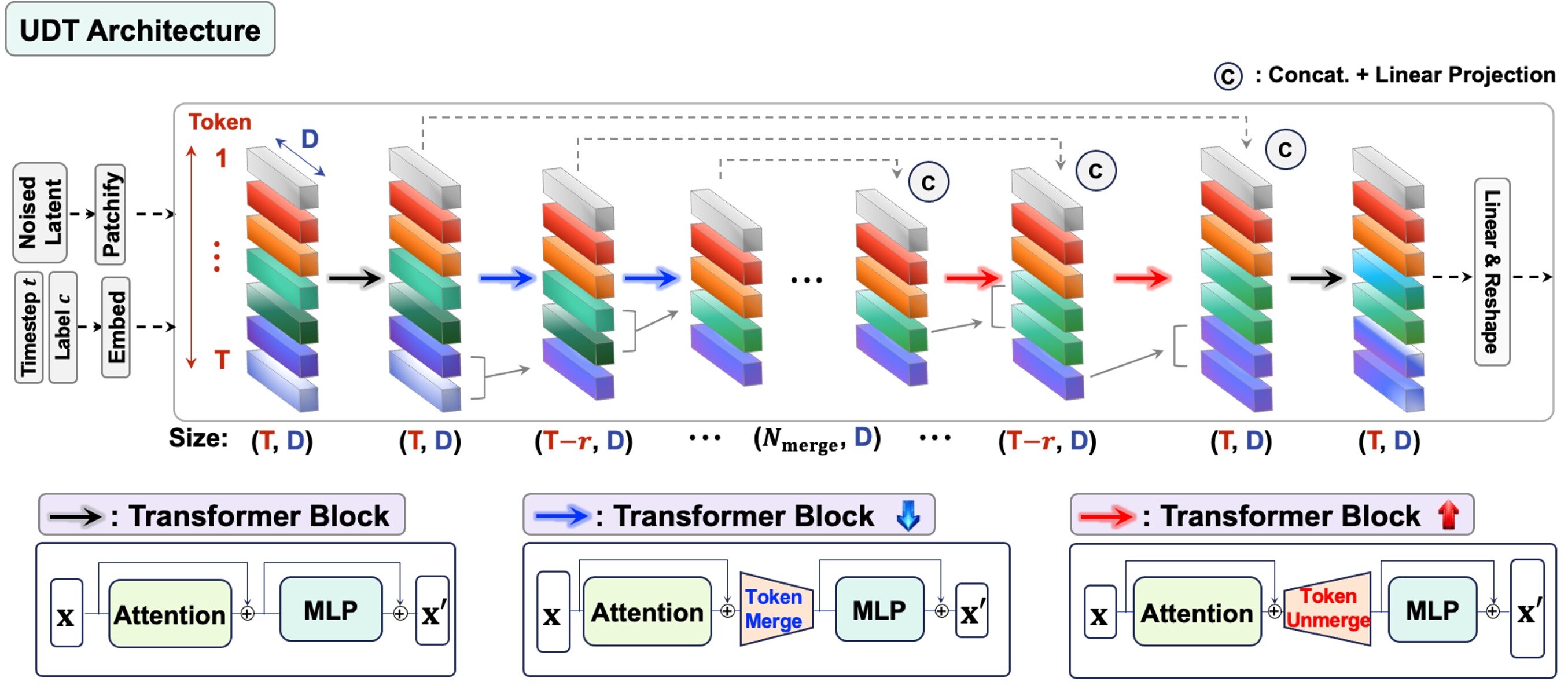
UDT turns a Diffusion Transformer into a U-Net using data-adaptive token merging/unmerging while keeping token dimensions fixed.
It preserves compatibility with existing DiT pipelines while substantially accelerating convergence and reducing computational costs.

AT A GLANCE

Generation quality & computational efficiency

ImageNet 256×256w/o CFG
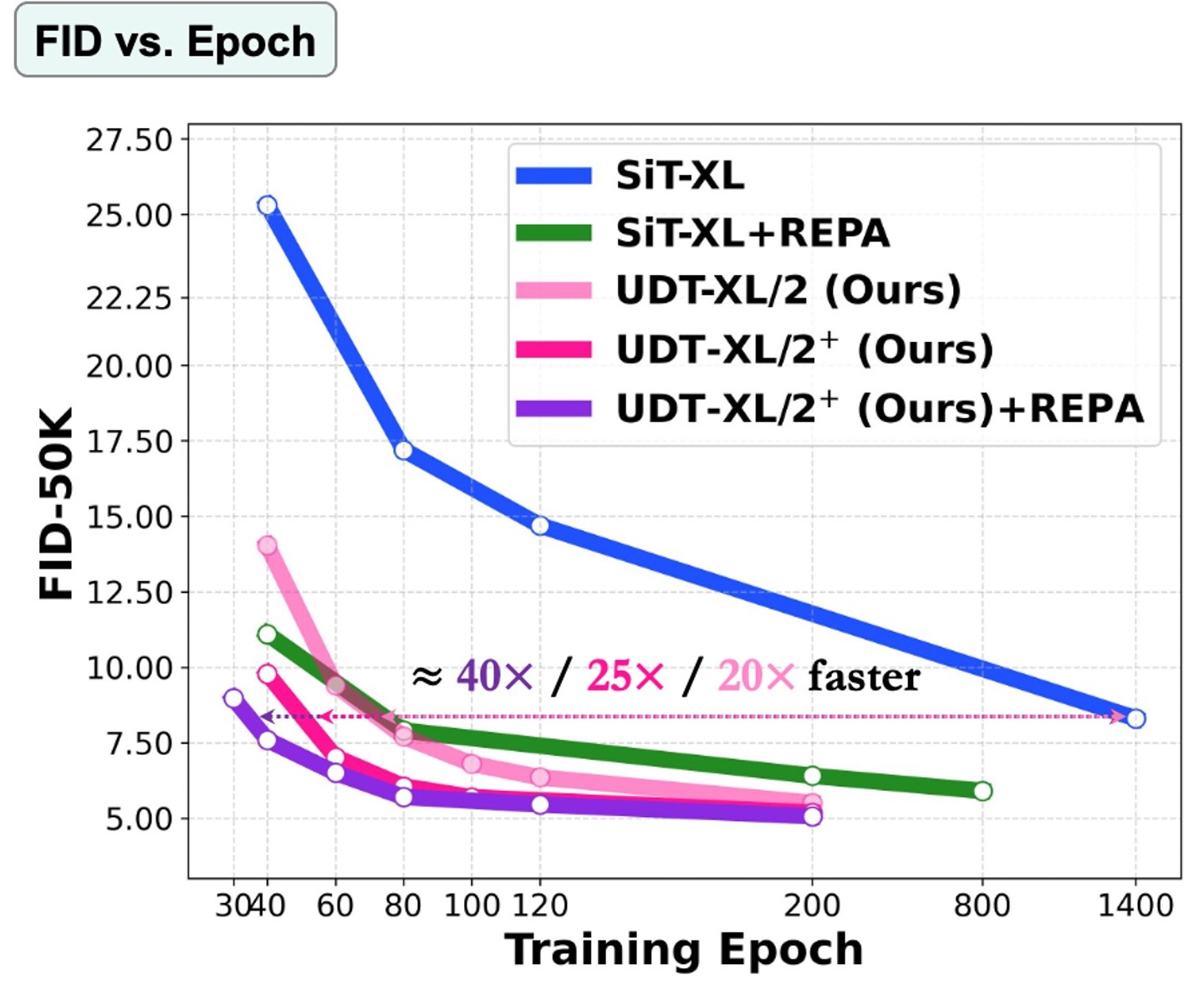
  • FID7.0at 60 epochs
    (UDT without REPA)
  • FID7.6at 40 epochs
    (UDT with REPA)
  • 25~40× faster
  • FID7.9at 1400 epochs (SiT)

Bars: training epochs, linear scale.

ImageNet 256×256with CFG
SD-VAE
  • FID1.42& IS 308.4 at 350 epochs (UDT without REPA)
  • FID1.38& IS 306.3 at 320 epochs (UDT with REPA)
VA-VAE
  • FID1.35& IS 322.0 at 500 epochs (UDT)
ImageNet 512×512with CFG
  • FID1.58& IS 327.7 at 200 epochs (UDT without REPA)
EpochGFLOPsFID↓IS↑
SiT-XL/2600524.62.62252.2
SiT-XL/2 + REPA200524.62.10274.6
UDT-XL/2100158.11.63320.5
UDT-XL/2200158.11.58327.7

* Note: FID samples are generated by randomly sampling class labels, i.e., without class-balanced sampling.

Computational benefits

1) UDT reduces the computational cost (faster inference) compared to isotropic DiT

At 256×256, UDT needs only ~0.77× the GFLOPs of SiT at every model size (B, L, XL) .

2) Compute stays low as resolution grows

Going from 256×256 to 512×512 raises the token count 4× (T = 256 → 1024).
SiT at 512×512 needs ~4.5× the GFLOPs , while UDT needs only 1.3–2.2× because token merging shortens the sequence .

B
UDT-B · 256×256: 17.7 GFLOPs17.7 SiT-B · 256×256: 23.0 GFLOPs23.0 UDT-B · 512×512: 49.8 GFLOPs49.8 SiT-B · 512×512: 106.4 GFLOPs106.4 4.6× 2.2× 0.77× UDTSiT UDTSiT 256×256512×512
L
UDT-L · 256×256: 61.9 GFLOPs61.9 SiT-L · 256×256: 80.7 GFLOPs80.7 UDT-L · 512×512: 116.1 GFLOPs116.1 SiT-L · 512×512: 361.0 GFLOPs361.0 4.5× 1.4× 0.77× UDTSiT UDTSiT 256×256512×512
XL
UDT-XL · 256×256: 91.6 GFLOPs91.6 SiT-XL · 256×256: 118.6 GFLOPs118.6 UDT-XL · 512×512: 158.1 GFLOPs158.1 SiT-XL · 512×512: 524.6 GFLOPs524.6 4.4× 1.3× 0.77× UDTSiT UDTSiT 256×256512×512
UDTSiT GFLOPs · arrows: ×GFLOPs relative to SiT at 256×256
01 — ABSTRACT

Why a U-Net Diffusion Transformer?

Diffusion Transformers (DiTs) have emerged as a core architecture in generative modeling due to their scalability and adaptability to multimodal tasks. DiTs comprise isotropic transformer blocks, and learn representations progressively across depth, where the denoising objective drives later layers to focus on fine-detail reconstruction. This results in degraded representation quality and an imbalanced encoder-decoder behavior. Prior approaches such as representation alignment (REPA) mitigate this by encouraging stronger early representations via training regularization. Alternatively, U-Net-style DiT architectures introduce explicit multi-scale encoder-decoder structures for improved convergence. But they build on standard U-Net wisdom via learnable operators for spatial downsampling, which are not well-suited to transformer architectures, introducing inefficiencies and compatibility issues with components such as cross-attention and representation regularization.

In this work, we propose UDT, a U-Net diffusion transformer that combines the representation power of DiTs with the encoding-decoding benefits of U-Nets, through data-adaptive token merging for downsampling and upsampling, while preserving the DiT token dimension. Our baseline UDT architecture outperforms existing U-Net DiTs and achieves performance comparable to REPA across all model sizes. Furthermore, using architectural optimization and REPA, UDT outperforms SiT's 7.9 FID at 1400 epochs (w/o CFG) within 40 epochs (~40× faster convergence) for XL model size on 256×256 ImageNet. Finally, it achieves strong image generation performance with CFG, reaching FID of 1.38 (320 epochs) with SD-VAE and 1.35 (500 epochs) with VA-VAE, providing a new backbone for DiTs with strong empirical benefits.

02 — GENERALITY

A drop-in backbone for isotropic DiT variants

Drop UDT into any isotropic DiT for faster training and better generation!

ImageNet 256×256ε-prediction

DiT

EpochFID↓(w/o CFG)
DiT-B/28043.5
UDT-DiT-B/28030.6
DiT-L/28023.3
DiT-L/2 + REPA8015.6
UDT-DiT-L/28013.5
DiT-XL/28019.5
DiT-XL/2 + REPA8012.3
UDT-DiT-XL/28011.2
ImageNet 256×256Pixel space

JiT

EpochFID↓(w/o CFG)FID*↓(w/ CFG)
JiT-B/165082.613.6
JiT-B/1620066.14.7
UDT-JiT-B/1610064.66.3
UDT-JiT-B/1620058.94.6
JiT-L/165062.26.9
JiT-L/1620048.03.0
UDT-JiT-L/165047.95.8
UDT-JiT-L/1620037.72.8
ImageNet 256×256Improved VAE

VA-VAE

EpochFID*↓(w/ CFG)IS*↑(w/ CFG)
LightningDiT-XL/1642.11252.3
UDT-XL/1641.99265.8
LightningDiT-XL/18001.35295.3
UDT-XL/15001.35322.0

MSCOCO 256×256Text-to-Image

MMDiT

Iter.FID*↓(w/ CFG)
MMDiT150K5.5
MMUDT150K4.7
03 — CITATION

BibTeX

@article{yun2026udt,
  title   = {UDT: Reconciling U-Nets and Diffusion Transformers with Data-Adaptive Token Reduction},
  author  = {Yun, Junno and Al{\c{c}}alar, Ya{\c{s}}ar Utku and Ak{\c{c}}akaya, Mehmet},
  journal = {arXiv preprint arXiv:2608.01298},
  year    = {2026}
}